


Traditionally, inclusive exam design has focused on providing individual adjustments for students who require them (Tai et al., 2024). While these arrangements remain important, the Universal Design for Learning (UDL) framework (CAST, 2024) encourages assessments to be designed to be accessible and inclusive for all students from the outset. Drawing on UDL principles, culturally responsive pedagogies, research and evidence-informed practices from universities internationally, we have identified eight principles of inclusive assessment to guide assessment design and practice at ANU. This section outlines these principles and connects their application to inclusive exam design.
What are the principles of inclusive assessment?
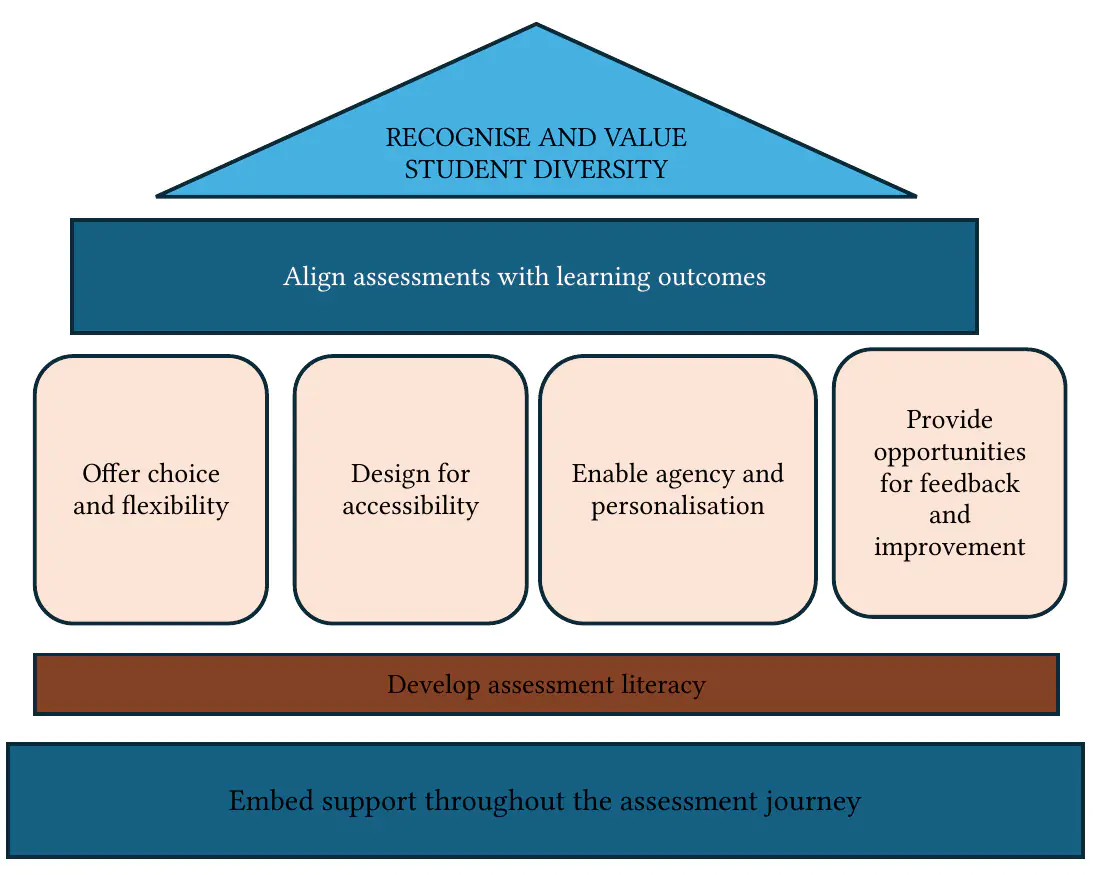
Figure 1 presents eight key principles of inclusive assessment within a house-shaped framework that brings these principles together. These principles are:
- Principle 1: Recognise and value student diversity
- Principle 2: Align assessments with learning outcomes
- Principle 3: Offer choice and flexibility
- Principle 4: Design for accessibility
- Principle 5: Enable student agency and personalisation
- Principle 6: Develop assessment literacy
- Principle 7: Provide opportunities for feedback and improvement
- Principle 8: Embed support through the assessment journey
What do these principles mean in inclusive exam design?
At the top of the framework is Recognise and value student diversity. This principle recognises that our students bring diverse backgrounds, experiences, identities, capabilities, and circumstances to their studies. Inclusive exam design moves away from designing for an “average” student and instead focuses on removing anticipated barriers for their learning and creating equitable opportunities for all students to demonstrate their learning.
Beneath the roof is Align assessment with learning outcomes. Exam design should focus on assessing the knowledge and skills specified in the course learning outcomes and avoid measuring unrelated factors wherever possible.
At the foundation of the framework is Embed support throughout the assessment journey. Support should be available before, during, and after exams. Before the exam, students should have access to clear information about exam requirements, permitted resources, preparation activities, practice opportunities and available support services. During the exam, students should be supported through accessible exam formats, clear instructions, appropriate technologies, and well-designed exam conditions. After the exam, students should have equitable access to results, feedback and information about next steps.
Built on this foundation is Develop assessment literacy. Students need to understand learning outcomes, exam expectations, criteria, standards, and feedback processes to engage confidently and effectively with exams.
At the centre of the framework are four key design principles:
- Offer choice and flexibility by providing appropriate options in exam format, conditions or tasks, while ensuring all students are assessed against the same learning outcomes and academic standards. Students can be offered choices of questions, topics, alternative case studies, open-book exams, or oral examinations where appropriate.
- Design for accessibility by proactively removing barriers and ensuring exams are accessible to a wide range of learners. This includes using clear instructions, accessible formats, and compatible technologies that accommodate a wide range of abilities and access requirements from students.
- Enable agency and personalisation by providing opportunities for students to make meaningful choices and draw on their own perspectives, experiences and strengths when responding to exam tasks. This helps students engage more authentically with the assessment while meeting the intended learning outcomes.
- Provide opportunities for feedback and improvement so that students can monitor their progress, develop their understanding, and improve performance over time.
Key message
Not every principle will be relevant to every exam, and these principles are intended mainly to support reflective practice in exam design. By considering them during the design process, we can identify opportunities to reduce unnecessary barriers, enhance student access and meaningful engagement, and ensure that exam results provide a fair and meaningful measure of student achievement.
For more practical guidance, please refer to this resource: Designing inclusive exams.
Further resources
1 Columbia University: Inclusive Teaching Principles
2 University of Bristol: Inclusive Assessment Principles
3 Council of Australian University Leaders in Learning and Teaching (CAULT): Leading Inclusive Assessment in Higher Education: A Framework to Guide Inclusive Practice
4 Inclusive Education: Design Assessments that Enable Students to Demonstrate their Understanding
References
Boud, D., & Falchikov, N. (2007). Rethinking assessment in higher education: Learning for the longer term. Routledge.
Center for Applied Special Technology. (2024). Universal Design for Learning Guidelines 3.0. CAST.
Nieminen, J. H. (2024). Assessment for inclusion: Rethinking inclusive assessment in higher education. Teaching in Higher Education, 29(4), 841-859.
Last updated: