


Inclusive exam design is no different to organising any other inclusive event. An inclusive event organiser would plan for different dietary requirements, mobility needs and communication preferences from the outset, rather than preparing a typical meal and addressing exceptions from participants’ requirements in the last minute. Similarly, an exam designer should consider diverse needs of students to make exams more inclusive from the beginning. Below is a range of considerations for inclusive exam design.
Exam timing
When planning invigilated, timed exams or oral examinations, course teams can consult with the Exams Office and consider students’ overall assessment workload across their studies. Although Programs of Study are designed to reduce timetable clashes and help distribute assessment demands, attention should also be given to periods where students may face multiple assessment deadlines. Thoughtful scheduling can help minimise cognitive fatigue and enable students to perform at their best.
Additional timing considerations apply to online and take-home examinations:
Timing in online exams
We can ask ourselves the following questions when designing online exams:
- Is it necessary for all students to sit the exam in a single sitting, or could a flexible exam window assess the same learning outcomes while improving accessibility and inclusion?
- What academic integrity risks, including the use of generative AI, might arise from a longer exam window? How can we minimise these risks?
Where appropriate, a flexible exam window, supported by tools such as Proctorio approved by ANU, can provide more equitable access for diverse student groups and reduce the need for deferred exams. Learn more from Dr Vicky Barnett about the use of Respondus Lockdown Browser (external website) at Curtin University. Similar to Proctorio, this tool supports a flexible exam window in which students can start the exam in a designated time period while still maintaining academic integrity.
Timing in take-home exams
When designing take-home exams, it is important to consider the impact of exam timing on student wellbeing. Submissions scheduled late at night, particularly Friday nights, can increase stress and anxiety and may affect students’ abilities to access support (academic, technical, or wellbeing). Where possible, we can align submission times with periods when support services are available, and students can seek timely assistance.
Exam length
Exam length should allow students to have sufficient time to engage with the tasks and perform their best. It is better to give an equitable opportunity for all students to engage in the exam over the same period, rather than to adjust exam length to suit specific learning needs.
To determine an appropriate time limit for an exam, these questions can be useful:
- Is the time limit for this exam pedagogically justified (e.g. reasonable time for each multiple-choice question, short answer or extended response questions)?
- Is the time limit for this exam piloted through previous cohorts?
- Does the exam reward speed?
- Could time pressure disadvantage students with dyslexia, ADHD, anxiety, chronic health conditions, cognitive processing differences or students using English as an additional language?
- Do students have time to review their work before submission?
Once these questions are carefully considered, the time set for an exam is the result of a well-considered process and represents an inclusive approach to exam design.
Constructive alignment between learning outcomes and exam questions
There are many types of questions that can be used in exams, with each suited to assessing different levels of cognitive complexity in Bloom’s taxonomy (Anderson & Krathwohl, 2001). The selection of question types should align with the cognitive level inherent in each course’s intended learning outcomes. An example of the blueprint (an exam plan) is provided on the constructive alignment (Biggs, Tang, & Kennedy, 2022) between learning outcomes and possible question types in a research methods course in Table 1.
Expand a learning outcome below the table to view its full wording and aligned course content.
Learning outcomes and course-content details
LO1: Identify key concepts, terminology, and principles used in quantitative and qualitative research
Course content: Research paradigms, variables, research ethics, quantitative and qualitative approaches
LO2: Explain the characteristics, strengths, and limitations of different research designs
Course content: Experimental, quasi-experimental, survey, case study, ethnography
LO3: Apply principles of research design to select appropriate methods for addressing research questions
Course content: Research questions, hypotheses, sampling, data collection methods
LO4: Interpret and evaluate research data, findings, and conclusions
Course content: Descriptive statistics, data interpretation, validity, reliability, trustworthiness
LO5: Analyse the methodological quality of published research studies
Course content: Research design, sampling, ethics, data collection, data analysis
LO6: Evaluate the suitability of different research approaches for addressing a research problem and justify an appropriate methodological choice.
Course content: Research design selection; methodological strengths and limitations; ethical considerations; justification of methods
Table 1
Example of an Exam Blueprint in a Research Methods Course
| LO | Bloom’s level | Assessment format | Questions | Marks | Weighting |
|---|---|---|---|---|---|
| LO1 | Remember / Understand | Selected Response — MCQs | Q1-Q11 | 10 | 10% |
| LO2 | Understand / Apply | Limited Response — Short-answer questions | Q11-Q15 | 15 | 15% |
| LO3 | Apply | Limited Response — Scenario-based short-answer questions | Q16-Q20 | 20 | 20% |
| LO4 | Apply / Analyse | Limited Response — Data interpretation questions | Q21-Q24 | 20 | 20% |
| LO5 | Analyse | Extended Response — Research critique | Q25 | 15 | 15% |
| LO6 | Evaluate | Extended Response — Methodology evaluation | Q26 | 20 | 20% |
| Total | 100 | 100% |
This blueprint demonstrates some good exam design practices. It helps academics:
- map every exam question to a specific learning outcome
- ensure all/ core learning outcomes are assessed and prevent over-assessment of some outcomes and omission of others.
- include a progression of questions from lower-order thinking (Remember, Understand, Apply) to higher-order thinking (Analyse, Evaluate) in Bloom’s taxonomy
- use multiple response formats appropriate to the intended learning outcome
- allocate weighting according to the complexity and importance of the learning outcome.
- cover a broad range of course content
Providing students with access to the exam blueprint can enhance their assessment literacy by making transparent the alignment between learning outcomes and assessments, assessment methods, question types, exam structure, and marking weightings.
Instructions and question design
To support students from various cultural, linguistic, and neurodivergent backgrounds, instructions must be clear, concise, and easy to follow (CAST, 2024). Different types of questions may need specific attention.
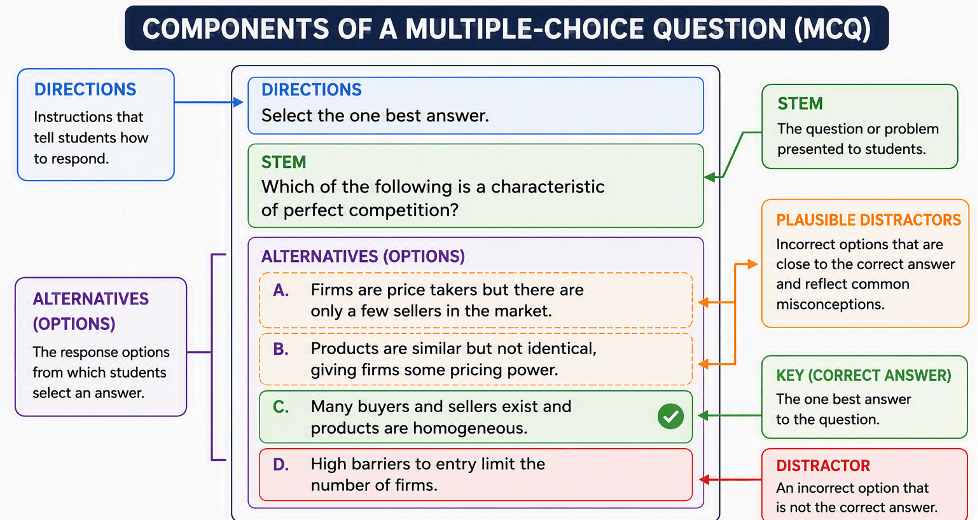
Selected response questions
Selected-response questions include multiple-choice questions, true/false, matching.
These questions should have:
- clear directions
- a focused stem
- options with similar length and structure, including one correct answer and plausible distractors
See Figure 1 for an example of a multiple-choice question.
Limited response questions (short answer questions)
A limited response question:
- focuses on a specific concept, issue, calculation, interpretation, or application.
- has a relatively narrow range of acceptable answers.
- usually worth few marks (e.g., 2-10).
- can often be answered in a paragraph, a few bullet points, a diagram, or a calculation.
A limited response question should:
- provide the context for the task (optional)
- explain what students are required to do [the task]
- outline any expectations for completing the task [expected response structure]
- indicate how marks are allocated
- estimated response length (where appropriate)
- assessment criteria (if they have not been communicated with students)
Extended response questions
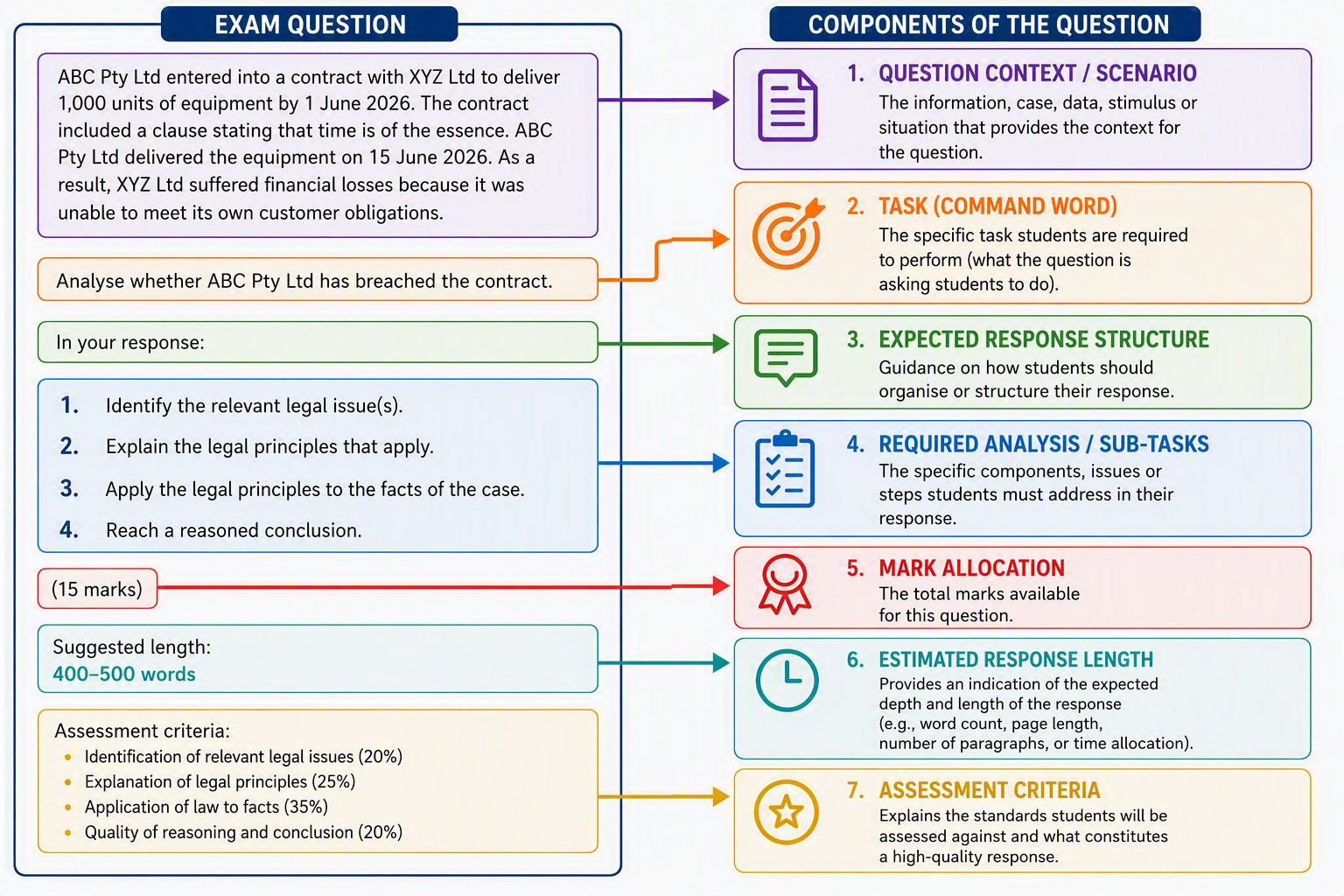
An extended response question should:
- provide the context for the task [the context/ scenario]
- explain what students are required to do [the task]
- outline any expectations for completing the task [expected response structure and sub-tasks]
- indicate how marks are allocated
- estimated response length (where appropriate)
- assessment criteria (if they have not been communicated with students)
See Figure 2 for an example of extended response question instructions in a law-specific course. The example is intended to show the structure of a question, not to evaluate its quality or content.
Offering choices and flexibility
A learning and teaching event organiser should provide multiple ways to engage attendees, such as different session formats (e.g., keynotes, workshops, panel discussion, engaging talks and networking sessions) and ways to contribute (e.g., presenting, facilitating discussion, or sharing resources). Similarly, inclusive exam design recognises that students can demonstrate learning in different ways by offering meaningful choices and increasing engagement in the assessment tasks. Exam designers can offer choices of questions, topics or case studies, as can be seen in the following examples in Table 2.
Table 2
Example of Choices and Flexibility in an Exam
| Choice of questions | Limited response (Short-answer question) | Answer TWO of the following THREE questions. Each question is worth 10 marks. |
| Choice of topics | Extended response | Analyse the factors affecting the price elasticity of demand for a product or service of your choice (e.g., coffee, petrol, public transport, airline travel). |
| Choice of case studies | Extended response | Study ONE of the TWO case studies provided. Answer the two accompanying questions. Each question is worth 10 marks. |
Cultural inclusion and bias considerations
- Use diverse perspectives, case studies or examples in exam questions where relevant, including Aboriginal and Torres Strait Islander and culturally diverse perspectives.
- Avoid cultural bias by reviewing questions for assumptions, references, or contexts that may disadvantage some student groups.
- Use culturally inclusive examples that are accessible to a broad range of students.
- Allow students to draw on their own cultural knowledge and experiences in extended response where relevant.
(CAST, 2024)
Accessible exam materials
Exam materials should follow the Universal Design for Learning guidelines (external website) (CAST, 2024) for materials design at ANU. Important considerations are highlighted in this section.
Clear exam layout and formatting:
- Use a minimum 12-point font, with a consistent heading hierarchy, formatting, and question numbering throughout the exam.
- Provide large-print versions of exam materials where appropriate.
Accessible visual materials:
- Use clear labels, readable fonts, and simple layouts in tables, graphs, diagrams, and images.
- Make colour-aware design choices in charts, graphs, and other visual materials, ensuring that meaning is not conveyed through colour alone. Use additional cues such as patterns, textures, labels, symbols, or line styles to distinguish data and support students with colour vision deficiencies.
- Provide alternative text for visual materials where appropriate to support students using assistive technologies.
Accessible digital materials:
- Ensure digital materials for online exams align with the Web Content Accessibility Guidelines (external website) (WCAG) 2.2 (W3C, 2023). Refer to ANU guidance about accessible digital content at ANU (internal website) for further information.
- Provide digital exam materials in accessible formats (e.g. tagged PDFs), ensure compatibility with screen readers, support keyboard navigation, and include alternative text for images and diagrams.
- Consider technology requirements and accessibility implications for online exams, including internet access, browser compatibility, webcam requirements, and built-in accessibility features.
- Use exam platforms and file formats that are compatible with assistive technologies, including screen readers, text-to-speech software, speech recognition software, magnification tools, and alternative input devices.
- Ensure that all exam functions can be completed using keyboard navigation and accessible controls, without relying solely on mouse interactions, drag-and-drop tasks, or visual prompts.
Open-book or closed-book exams
- Design exam questions that focus on application, analysis, evaluation, and problem-solving rather than memory recall alone. Open-book exams may reduce stress and remove some barriers for students, including students with disability (Tai et al., 2023).
Provide additional exam support
- Share exam blueprint, sample questions, or practice exams to help students understand what will be assessed.
- Identify and implement approved exam arrangements and reasonable adjustments in advance.
- Offer opportunities for students to ask questions about exam requirements and procedures
- Prepare for individual exam arrangements and reasonable adjustments and provide approved exam arrangements, such as additional time, rest breaks, assistive technologies, alternative formats, or adjusted exam conditions.
- Ensure technical and administrative support is available for computer-based or online exams.
- Provide timely results and feedback, where appropriate.
- Support students affected by adverse circumstances through Extenuating Circumstances Applications (ECAs).
- Review exam outcomes and student feedback to identify opportunities for improving accessibility, inclusion, and assessment quality.
Key messages
- Apply the eight principles of inclusive assessment when designing inclusive exams.
- Use the Inclusive exam design checklist to review exam inclusivity and accessibility.
Further resources
1 ADCET: Re-imagining Exams – Inclusive Assessment Resources
2 UNSW: Assessing Inclusively
3 Curtin University: Understanding Exams at Curtin
References
Anderson, L. W., & Krathwohl, D. R. (Eds.). (2001). A taxonomy for learning, teaching, and assessing: A revision of Bloom’s taxonomy of educational objectives. Longman.
Biggs, J., Tang, C., & Kennedy, G. (2022). Teaching for quality learning at university (5th ed.). McGraw Hill.
Center for Applied Special Technology. (2024). Universal Design for Learning Guidelines 3.0. CAST.
Harris, L. R., Tai, J., Mahoney, P., Dargusch, J., Bearman, M., & Ajjawi, R. (2026). An intersectional analysis of students with disabilities’ exam experiences. Teaching in Higher Education, 31(2), 304-322.
Tai, J., Mahoney, P., Ajjawi, R., Bearman, M., Dargusch, J., Dracup, M., & Harris, L. (2023). How are examinations inclusive for students with disabilities in higher education? A sociomaterial analysis. Assessment & Evaluation in Higher Education, 48(3), 390-402.
World Wide Web Consortium (W3C). (2023, October 5). Web Content Accessibility Guidelines (WCAG) 2.2. Web Accessibility Initiative (WAI).
Last updated:
The figures were created using Microsoft Copilot based on given prompts.