


This resource compares analytic rubrics and holistic rubrics. We explore their common uses and variations.
There are two types of rubrics that are commonly used:
- Analytic rubrics
- Holistic rubrics
These rubrics can be designed either task-specifically or generally. Whether a rubric is analytic or holistic is independent of whether it is general or task-specific.
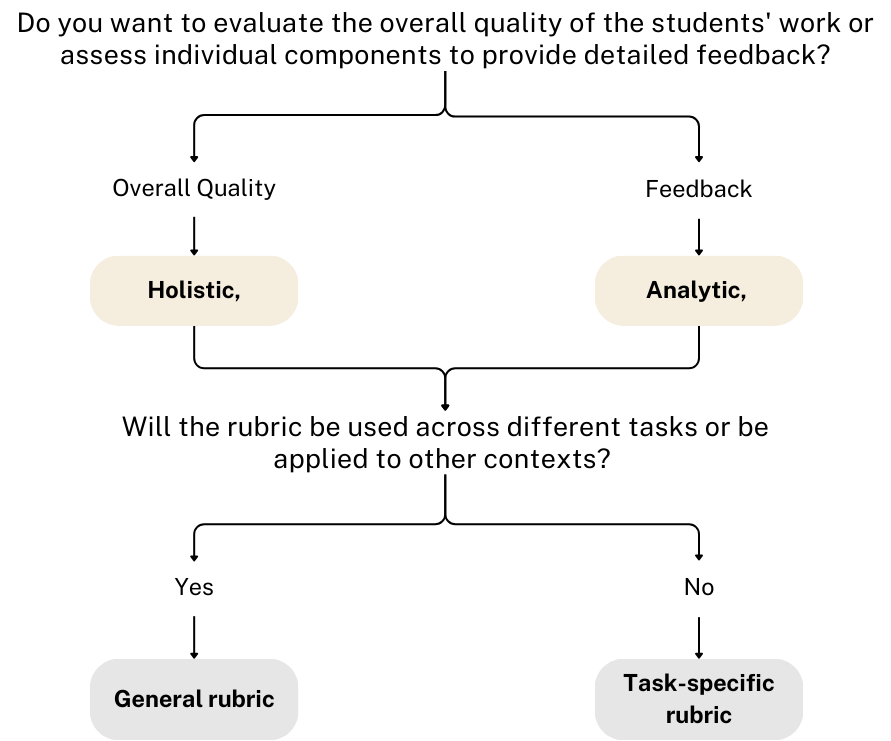
For example, we could have a holistic, general rubrics or an analytic, task-specific rubrics. Refer to the decision tree to determine type of rubric to use.
An analytic rubric evaluates criteria one at a time. Since it is used to evaluate specific elements of students’ work, it provides detailed feedback to students (Nitko & Brookhart, 2013).
Common uses
- When the assessment involves multiple criteria that need to be assessed separately.
- When providing specific feedback to students.
- When involving multiple markers.
- When encouraging students to self-assess or evaluate their own work.
Visit our sample rubric collection for examples of analytic rubrics.
A holistic rubric requires the marker to make a judgement on the overall quality of student work as a whole without scoring each criterion separately. Compared to an analytic rubric, which has multiple criteria, a holistic rubric only has one criterion.
Common uses
- When evaluating the overall quality, performance, and understanding of a specific topic rather than focusing on individual components
- When the criteria are complex, interwoven, and difficult to distinguish from one another.
- When errors in some part of the process can be tolerated provided the overall quality is high.
- When there is no definitive correct answer (Nitko & Brookhart, 2013).
- When detailed feedback is not always necessary, such as in final exams.
Visit our sample rubric collection for examples of holistic rubrics.
A task-specific rubric is designed to support the specific content of a particular task (for example, drawing a conclusion on a selected case study). This type of rubric is more specific but less transferable.
Common uses
- When the course has specific learning outcomes that require precise alignment with the assessment
- When the assessments involve multiple criteria that are unique to the specific assessment piece
Visit our sample rubric collection for examples of task-specific rubrics.
In a general rubric, descriptors are developed based on the characteristics of a general competence or task (for example, writing skills). General rubrics could be reused with broader applicability, for a range of individual tasks (i.e., task-type rubrics), or even at a department-wide or institution-wide level.
Common uses
- When there are commonalities of criteria across subjects or disciplines.
- When a common standard for assessment is needed to compare student performance over time.
Visit our sample rubric collection for examples of general rubrics.
Specific variations of rubrics
| Task specific (only applicable to one task or assessment) | General (can be applied to other tasks or contexts) | |
| Analytic rubric (multiple criteria) | Analytic, task specific rubric | Analytic, general rubric |
| Holistic rubric (one general criterion) | Holistic, task specific rubric | Holistic, general rubric |
The matrix shows the specific variations of rubrics, with four variations including:
- analytic task-specific rubrics
- analytic general rubrics
- holistic task-specific rubrics, and
- holistic general rubrics.
Rubric decision tree
This decision tree guides educators in selecting the appropriate rubric type.
- For overall evaluation of student work, choose ‘Holistic’
- For detailed feedback on individual components, choose ‘Analytic’.
Then, if the rubric will be applied across different tasks or contexts, select ‘General rubric’; otherwise, choose ‘Task-specific rubric’. The tree helps identify the best rubric combination based on specific needs.
References
Nitko, A. J., & Brookhart, S. M. (2013). Educational v 6th ed.). Pearson.