


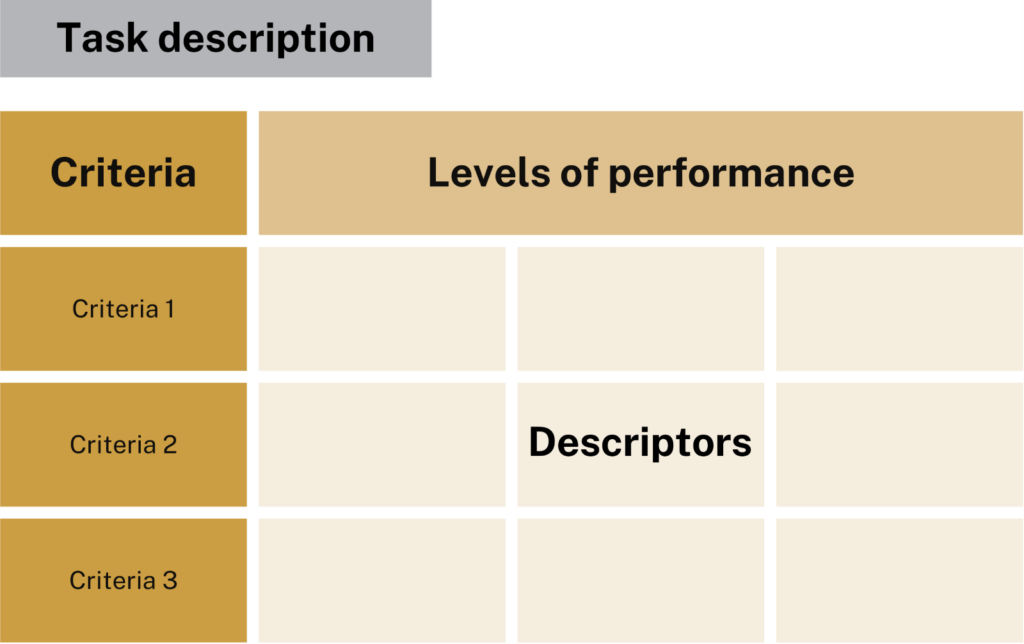
Effective rubrics are built upon four fundamental elements: task description, criteria, performance levels, and descriptors. After writing the task description and selecting the rubric type, follow the principles below when designing the three elements of a rubric.
Criteria
Consider: What characteristics of student work provide evidence for student learning of the knowledge or skills specified in the learning outcome?
The criteria:
Levels of performance
It is recommended to use the following grading scale from the ANU Student assessment (coursework) policy (opens in new window) as performance levels, if there are no specific accreditation or discipline requirements. The actual numerical grade calculation may vary depending on the context of your college and school within your discipline.
| Grades | |||||
| High Distinction (HD) | Distinction (D) | Credit (C) | Pass (P) | Fail (N) | |
| Numerical Mark (%) | 80 – 100 | 70 – 79 | 60 – 69 | 50 – 59 | 0 – 49 |
| Standards | Work of exceptional quality, as demonstrated in the attainment of learning outcomes at or above the relevant qualification level | Work of superior quality, as demonstrated in the attainment of learning outcomes at or above the relevant qualification level | Work of good quality, as demonstrated in the attainment of learning outcomes at or above the relevant qualification level | Work of satisfactory quality, as demonstrated in the attainment of learning outcomes at or above the relevant qualification level | Work in which the attainment of learning outcomes at or above the relevant qualification level has not been demonstrated |
Please note: this grading scale is derived from the ANU grading system outlined in the policy. It is not intended to serve as a rubric descriptor. The provided Standards represent generic ANU grade descriptors, and it should align with the performance levels in our rubric.
Advantages of the ANU grading system
Adopting this grading scale as the performance levels implies that students’ work will be evaluated on a five-point scale (HD, D, C, P, N). This approach presents several advantages:
- Firstly, it is familiar to ANU students, minimising confusion.
- Secondly, it streamlines the marking process and facilitates conversion into numerical scores for reporting purposes.
- For smaller or lower-weighted assessment tasks, such as 10-15%, using grade ranges (HD-D, C-P, N) can simplify the grading process.
Other performance levels
In addition to ANU grades, other performance levels in a taxonomy (opens in new window) can also be used, such as these:
- Bloom’s Cognitive Taxonomy
- Biggs and Collis’ SOLO Taxonomy
- the adapted levels in TEQSA’s Assessment Rubric Guide (Developing, Functional, Proficient, Advanced)
However, this requires additional steps to assign a range of marks to performance levels and align with the ANU grading scale later for reporting purposes.
For instance, if an assessment total score is 100, then ‘Advanced’ is equivalent to 85+; ‘Proficient’ is between 70-84 points; ‘Functional’ is 51-69 and ‘Developing’ is 0-50.
Grades can be awarded based on performance levels and later converted to the ANU grading scale (HD, D, C, P, N). Students should be communicated clearly about the levels prior to the assessment task.
Descriptors
After deciding on the number of performance levels, start writing descriptors for each level and criterion. Start by writing the level intended for most students to reach (i.e., Credit), then adjust it accordingly. Another way is to start with the top level (i.e., High Distinction), then work backwards.
Consider: What does student work look like at each level of quality, from high to low, on this criterion?
The descriptors should be (Brookhart, 2013, p.28):
This word bank resource (also available in additional resources) was developed by Cordiner (2010) and provides useful phrases and language to write rubric descriptors. Section 7 is particularly helpful in providing examples of how to avoid ambiguous and vague language in our rubrics.
References
Brookhart, S. (2013). How to create and use rubrics for formative assessment and grading. ASCD.
Cordiner, M. (2010). Word banks for use in writing criteria sheets. University of Tasmania. https://www.teaching-learning.utas.edu.au/__data/assets/word_doc/0012/51303/word-banks-handout-.doc
Wolf, K., & Stevens, E. (2007). The role of rubrics in advancing and assessing student learning. The Journal of Effective Teaching, 7(1), 3-14. https://files.eric.ed.gov/fulltext/EJ1055646.pdf