


The ANU EFS supports the University’s strategic objectives for learning and teaching by providing a scaffolded pathway to internationally accredited professional recognition, enabling staff to reflect on and showcase their practice through Associate Fellowship (AFHEA), Fellowship (FHEA), Senior Fellowship (SFHEA) and Principal Fellowship (PFHEA).

- Gain international professional recognition. Achieve an internationally recognised fellowship with Advance HE, demonstrating your commitment to teaching and learning in higher education and recognising your professional practice.
- Reflect on and showcase your practice on teaching and learning. The application helps you turn everyday teaching, supervision, curriculum, assessment or educational support work into a clear evidence-based professional narrative.
- Grow your leadership and strategic impact. Develop your leadership in teaching and learning by gaining insights into different approaches and learning from the experiences of others. By participating as a Committee member, assessor, mentor, or workshop facilitator, you will also contribute to an important ANU strategic initiative that supports excellence and leadership in education.
- Support your career progression. Strengthen your professional profile by gaining formal recognition of your teaching and learning practice, providing valuable evidence of your experience, impact and ongoing professional development. Once you are a member of the EFS, you are entitled to use the post-nominal of your category after your name (for example, John Smith SFHEA).
- Build connections with colleagues across ANU and beyond. Expand your professional network by connecting with colleagues who share an interest in teaching and learning. Become part of a supportive community at ANU and build relationships with educators and professionals across the higher education sector.
Application Journey
Applying for an Advance HE Fellowship through the ANU EFS is free of charge. To be eligible, you must:
- Be a current ANU employee, student or honorary appointee with an ANU email address.
- Commit to upholding the Fellowship Code of Practice – Advance HE Global.
- Be willing to contribute to the ANU EFS community, for example as an EFS mentor, assessor or speaker.
The Professional Standards Framework = the framework you are being assessed against.
EFS application = your evidence and reflection demonstrating how you meet that framework.
As of 2026, the Professional Standards Framework 2023 (the PSF 2023) is the latest version of Advance HE’s globally recognised framework for benchmarking excellence in higher education teaching and learning support.
The PSF 2023 is the framework against which your application will be assessed and defines key terminology, including Dimensions, Descriptors, Professional Values, Core Knowledge, and Areas of Activity. Applicants and their referees should therefore familiarise themselves with the framework.
Link to the PSF 2023: Professional Standards Framework for teaching and supporting learning in higher education 2023 – Advance HE Global.
A5 Card version: Advance-HE-PSF-2023-A5-Cards.pdf.
Postcard version: Advance-HE-PSF-2023-Postcards.pdf
PSF 2023 Dimensions – mapped against Descriptors
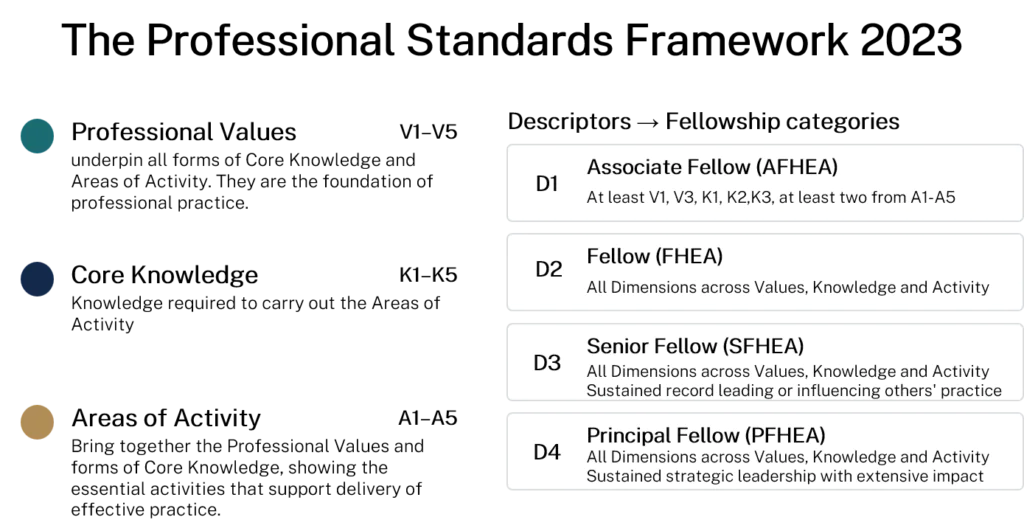
There are four categories of Advance HE Fellowship, align with the four Descriptors in the PSF 2023. These categories recognise different levels of educational practice and experience:
- D1: Associate Fellow (AFHEA)
- D2: Fellow (FHEA)
- D3: Senior Fellow (SFHEA)
- D4: Principal Fellow (PFHEA)
It’s not your job title that determines your category. It’s the scope, responsibility, influence and impact of your educational practice.
Use the Advance HE Fellowship Decision Tool to evaluate which level is likely right for you.
If you are between two categories (e.g. Associate Fellow (D1) and Fellow (D2)), we recommend applying at the lower level.

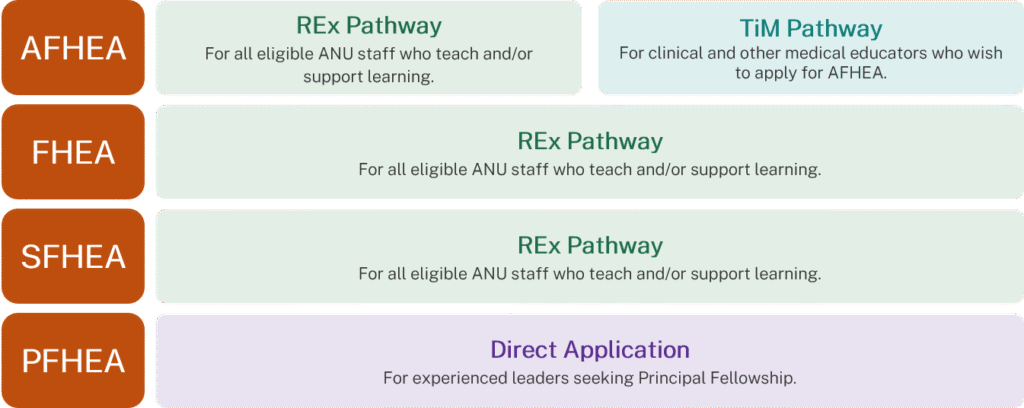
The Reflection on Experience (REx) pathway
The REx pathway is the most common route at ANU. It provides a scaffolded professional development opportunity to three categories of Advance HE Fellowships: Associate Fellowship (AFHEA), Fellowship (FHEA), and Senior Fellowship (SFHEA).
Please note that AFHEA and FHEA applications are written only. SFHEA applications include both a written application and a Professional Conversation (PC), which will be arranged after the written application submission window.
For the written application, additional documents or appendices, such as a curriculum vitae or résumé, as well as diagrams, images, hyperlinks or other supplementary elements, are not required and should not be included.
For SFHEA applicants, the PC provides an opportunity to explore elements of the written application in greater depth, clarify or address gaps, and present relevant physical supporting evidence or artefacts.
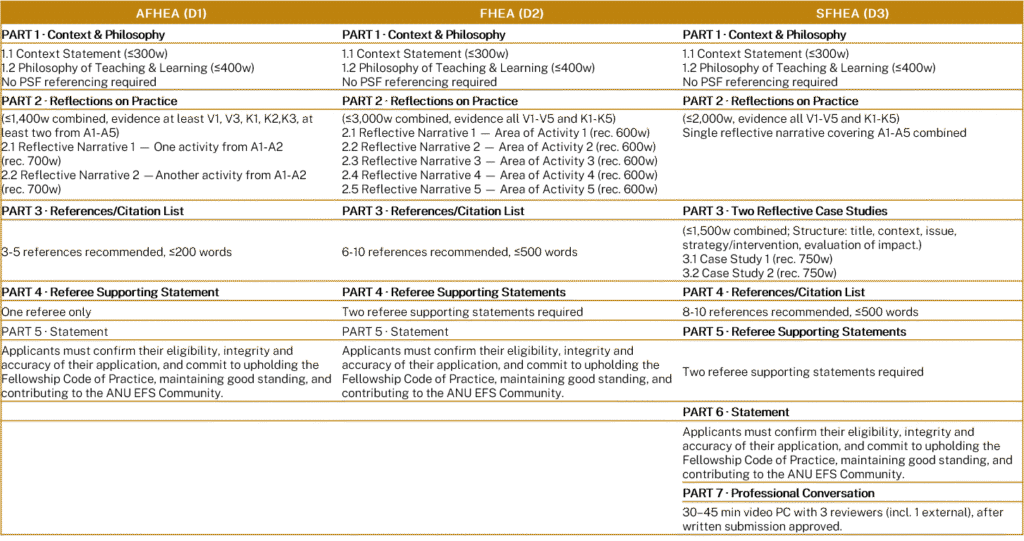
*Full details see application guidance.
The Teaching in Medicine (TiM) pathway
ANU offers a Teaching in Medicine (TiM) pathway for clinical and other medical educators who wish to apply for AFHEA. Learn more about the TiM pathway below. Note that clinical and other medical educators who wish to apply for a FHEA or SFHEA will need to join the Reflection on Experience (REx) pathway.
For those choosing the TiM pathway, please contact efs@anu.edu.au and we will refer you to our TiM pathway lead Clinical Professor Katrina Anderson, SFHEA.
This pathway is available through the ‘Teaching for Clinicians’ course run by the Canberra Region Medical Education Council (CRMEC). ‘Teaching for Clinicians’ is a course that is offered to all doctors working across the public health system in Canberra and South-East NSW.
In order to qualify for the TiM pathway to AFHEA, you must be:
- teaching ANU medical students for at least 12 months in the clinical environment;
- fully registered as a medical practitioner;
- have attended the ‘Teaching for Clinicians Course’ Part 1 and Part 2: Education — Canberra Region Medical Education Council
This course is run twice yearly and is open to all doctors who are supervising and teaching in the clinical context of patient care.
Direct Application (PFHEA only)
ANU does not award Principal Fellowship of the Higher Education Academy (PFHEA) directly but supports applicants seeking this level of recognition through direct application to Advance HE. Please contact efs@anu.edu.au and we will connect you with our PFHEA application lead Professor Michael Martin, PFHEA.
Read the Guide to the PSF 2023 Dimensions for the Fellowship level you are applying for. This Guide provides practical guidance on developing your application, including:
- further explanation of the PSF 2023 Dimensions required for the Fellowship level you are applying for;
- illustrative examples for each Areas of Activity (A1-A5), Professional Values (V1-V5), Core Knowledge (K1-K5)
Use the examples as prompts to identify your own relevant examples and evidence.
Important: Provide recent and relevant examples from your practice
For Associate Fellowship (D1), or Fellowship (D2), your evidence should draw on your practice from the last 3 years.
For Senior Fellowship (D3), you need to demonstrate a sustained record of leading or influencing (D3.1). Your evidence should draw on your practice over the last 3–5 years.
We recognise that individual circumstances may sometimes result in a gap in engagement with educational practice, and we are committed to being inclusive and equitable.
If this applies to you and you’re concerned about having sufficient recent evidence, please get in touch at efs@anu.edu.au. We’re happy to support you and discuss your circumstances.
The Applicant Guidance should be used alongside the Guide to PSF 2023 Dimensions.
The Guide to PSF 2023 Dimensions explains the Professional Values, Core Knowledge and Areas of Activity, and helps you identify relevant evidence from your practice.
The Applicant Guidance focuses on how to organise, articulate and present that evidence effectively in your application. It also includes worked examples to help you understand how to approach and write each section.
We strongly encourage you to make use of the support and resources available to develop a strong application.
Take the time to submit an application you feel confident in. If you are unsure whether your application is ready or need advice, please do not hesitate to reach out (efs@anu.edu.au) before submitting.
More information can be found in the section below “Support and Resources”.
Your referee plays an important role in your application. They will provide a Supporting Statement that verifies and endorses your evidence and can provide constructive feedback to help strengthen your application.
We strongly recommend that you identify and contact your referee early in the application process. This gives you time to discuss your practice, share your draft application, and incorporate their feedback before you submit.
Choose a referee who knows your practice
Your referee should:
There is no requirement for your referee to be an Advance HE Fellow. However, your referee will need to familiarise themselves with the PSF 2023 Guide and the Descriptor relevant to your application. A referee who is already an Advance HE Fellow will be particularly helpful because they are likely to be familiar with the PSF 2023 and the expectations of a Fellowship application.
Work with your referee
Once you have identified your referee:
Please also share the Guidance for Referees with your referee(s). The supporting statement template will be provided as part of the application form.

Please download the application form and submit the complete application (including the referee supporting statements), via the EFS Application Submission Portal, by 30 October 2026.
If you encounter any issues, please contact us via efs@anu.edu.au.
Key Dates for the Application
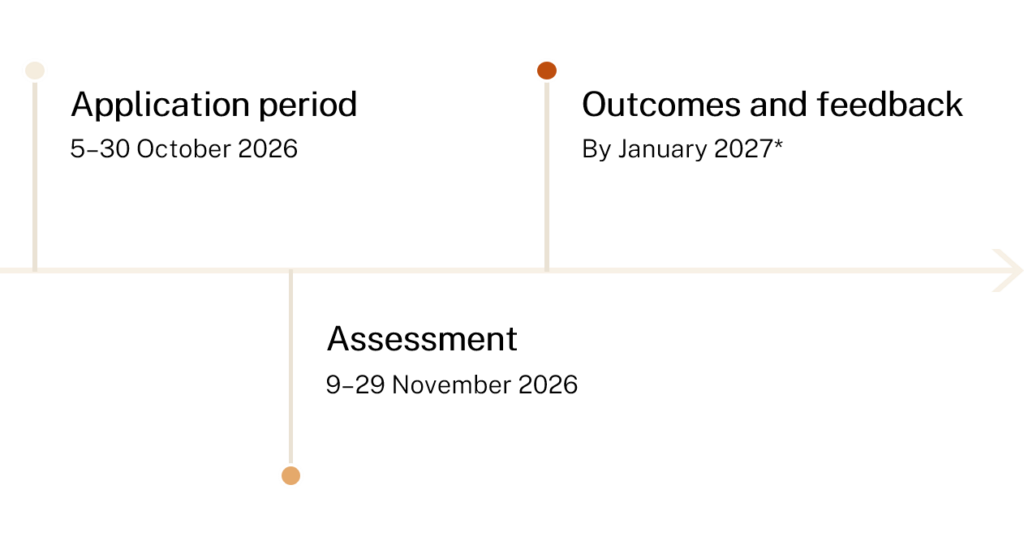
* Timeframes may vary depending on assessor capacity, moderation processes, and other factors. We aim to finalise outcomes as quickly as possible and appreciate your patience.
Support and Resources
A focused writing session for EFS applicants.
Need some dedicated time and space to make progress on your EFS application?
Bring your laptop and come along for focused writing sprints in a supportive environment. Register here: EFS Shut Up & Write.
No critiques. No pressure. Just protected writing time and the company of peers who, like you, are working towards their EFS application.
Experienced Fellows will also be available to answer questions and discuss your application if you need some guidance along the way.
Our EFS Information Session provides an introduction to the Scheme and practical guidance to help you understand the Fellowship pathways, application process and what to expect along the way.
Whether you’re considering applying for the first time or looking to progress to the next level of Fellowship, we encourage you to watch the recording and explore the resources below.
Watch the session recording
We’ve also compiled the questions raised during the session, along with our responses, to help you find answers to some of the common questions about EFS.
For all applicants. This workshop covered key elements of an application, including:
- articulating your educational philosophy;
- developing reflective narratives and case studies;
- selecting and presenting appropriate evidence; and
- demonstrating alignment with the expectations of the relevant Fellowship category.
Watch the recording: EFS Writing Workshop 2026
Monday, 19 October | 10:00–11:00 am | In person
Register here: EFS Senior Fellowship Professional Conversation Workshop
Join Dr Marina Iskhakova, SFHEA and EFS Committee Member, for the EFS Senior Fellowship Professional Conversation (SFHEA PC) Workshop.
This session is designed specifically for SFHEA applicants and will help you prepare for the Professional Conversation component of the Senior Fellowship application. Marina will share practical insights into the Professional Conversation process and what to expect, with an opportunity to discuss how to prepare a strong written application that sets you up for a successful Professional Conversation.
Applicants are strongly encouraged to connect with an experienced Fellow for one-to-one support.
- A list of Fellows can be found here: EFS Community – ANU Learning and Teaching.
- Identify a Fellow at the level you are applying for and reach out to them directly, cc’ing our team (efs@anu.edu.au) in your initial email so we can provide support if needed.
- Arrange the mentoring between yourself and your mentor as you see fit.
The expectation is that the mentor will provide at least one review of your application. Mentors and applicants may agree to additional meetings or feedback if mutually convenient.
Please refer to: Context statement – ANU Learning and Teaching.
Please refer to: Philosophy of Teaching and Learning Guidance – ANU Learning and Teaching.
Watch a recording from an EFS Group Mentoring Workshop_ Reflective Narrative:
2026 EFS Reflective Narrative Workshop
Download the slides:
Watch a recording from an EFS Group Mentoring Workshop_ Case Studies (for FHEA and SFHEA applicants:
2026 EFS Reflective Case Studies Workshop
Download the slides:
Other resources:
Please note that the following SFHEA case study excerpts were written against Professional Standards Framework 2011 (PSF 2011). We thank the Senior Fellow who generously shared these examples anonymously for the benefit of the EFS community.
Learn more about the Fellowship journey through The Advance HE Fellowship Podcast, featuring conversations about the benefits of Fellowship, application tips, and inspiring stories from Fellows sharing their experiences and pathways to achieving Fellowship.
- Fellowship to enhance teaching and learning
- Using reflection to evidence effective and inclusive practice for fellowship
- AFHEA: Associate Fellowship/Descriptor 1
- FHEA: Exploring Fellowship – Descriptor 2
- SFHEA: Introduction to Senior Fellowship
- PFHEA: Applying for Principal Fellowship
- Advocacy and Supporting Statements
If you need any further information or support, please contact us via efs@anu.edu.au at any time. Looking forward to your application!